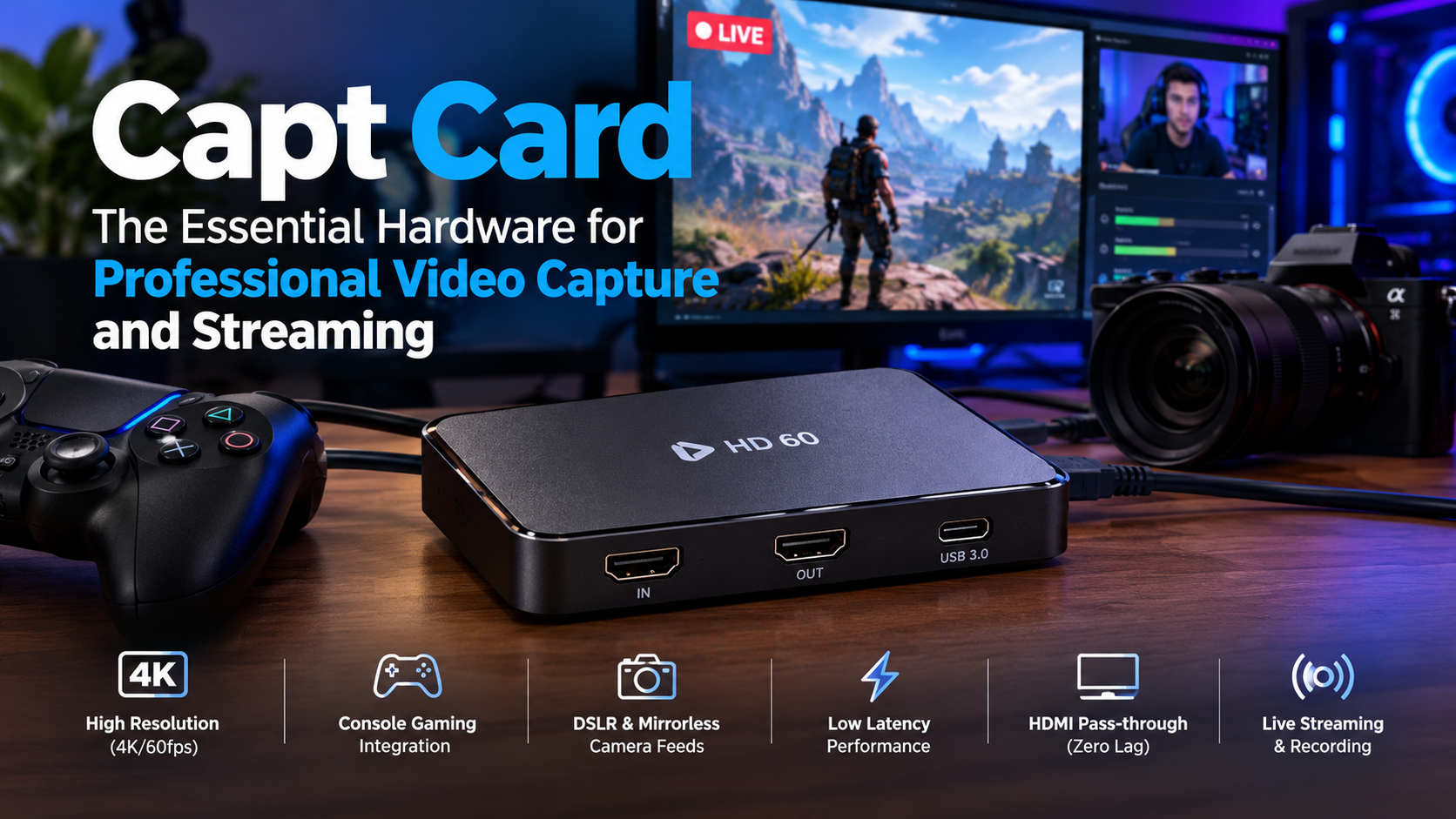
Complete SEO Article
For video creators, YouTubers, live streamers, and digital filmmakers, capturing pristine video footage is a foundational requirement. Whether you are broadcasting live gameplay on Twitch, recording console walkthroughs, or routing professional camera feeds into a production switcher, standard software screen recording often falls short. This is where a capt card—commonly known as a capture card—comes into play. Understanding what a capt card is, how it functions, and how to choose the right one can dramatically elevate the production value of your content.What Is a Capt Card?
A capture card is a dedicated piece of hardware designed to take a video and audio signal from an external source—such as a gaming console, DSLR camera, camcorder, or secondary computer—and process it so your primary computer can record or stream it. Unlike software recorders that capture your desktop by taxing your computer's CPU or GPU, a capture card handles the heavy lifting of encoding and video processing independently. It sits between your video source and your main workstation, acting as a high-speed bridge.How Capture Cards Work
- At its core, a capt card performs a straightforward technological process:
- Processing & Encoding: The card processes the incoming feed. Some entry-level cards are "software encoders" (reliant on your computer's processor to compress the video), while professional cards feature "hardware encoders" that compress the video on-chip.
- Signal Output: The processed feed is transmitted to your computer via USB (USB 3.0 or Type-C) or PCIe slot, allowing software like OBS Studio, Streamlabs, or Adobe Premiere Pro to view, record, or broadcast the feed. Many cards also feature an "https://aestheticedits.site/HDMI pass-through" port, sending a zero-lag signal to a secondary monitor or TV so you can play or monitor in real time without delay.
Types of Capture Cards
Choosing the right capt card depends entirely on your setup, workflow, and equipment. They generally fall into two primary categories:
- Internal Capture Cards: These are PCIe expansion cards that you install directly into the desktop computer. They offer ultra-low latency, reliable high-speed data transfer, and do not take up external desk space or USB ports. They are ideal for dedicated dual-PC streaming setups.
- External Capture Cards: These are standalone box-like devices that connect to your computer via USB or Thunderbolt. Their primary advantage is portability. They can easily be disconnected and used with laptops, making them popular for mobile creators, event videographers, and console gamers who travel.
Why Video Creators Need a Capt Card
While screen capture software is fine for basic desktop tutorials, content creators across various niches rely on hardware capture cards for several critical reasons:
- Uncompromised Quality: Capture cards allow you to record and stream in high resolutions and frame rates, such as 4K at 60 frames per second or 1080p at 240Hz, without stuttering or dropping frames.
- Console Gaming Integration: Consoles like the Xbox Series X, PlayStation 5, and Nintendo Switch cannot easily run native streaming or recording software while gaming heavily. A capture card lets you pipe console footage seamlessly into a PC for broadcasting.
- Professional Camera Clean Feeds: Many modern creators use mirrorless or DSLR cameras as webcams for high-end YouTube talking-head videos or professional live streams. A capture card strips away camera overlays and delivers a clean, high-definition HDMI feed.
- Reliable Resource Management: By offloading video encoding to dedicated hardware, your computer maintains peak performance for running games, editing timelines, or managing heavy broadcast overlays.
Key Factors to Consider Before Buying
Before purchasing a capt card, evaluate your technical requirements to ensure compatibility:
- Resolution and Refresh Rate Support: Match the card's capabilities to your display goals. If you play games at 4K/120Hz, ensure your pass-through and recording specs support it.
- Interface Compatibility: Check whether your computer has an available PCIe slot (for internal cards) or a high-bandwidth USB 3.0/Type-C port (for external cards).
- Software Compatibility: Ensure the card integrates smoothly with your preferred production software, whether that is OBS Studio, vMix, XSplit, or major editing suites.
FAQs
Internal capt cards install directly into a desktop motherboard via a PCIe slot, offering maximum speed and zero desk clutter. External capt cards connect via USB or Thunderbolt, offering portability and compatibility with laptops and mobile setups.
Do I need a capt card if I only edit pre-recorded videos? Generally, no. If you record footage directly onto an SD card in your camera or use local screen recording software, you do not need a hardware capture card to edit those files in software like Premiere Pro or DaVinci Resolve. Capture cards are primarily for real-time streaming, pass-through monitoring, and capturing external device feeds.
Can I use a capt card with a laptops?
Yes, but you must use an external USB or Thunderbolt capture card, as laptops do not have internal PCIe slots for expansion cards.
Secondary Keywords
- Video capture card
- External capture card
- Internal PCIe capture card
- 4K capture card
- Stream capture device
- HDMI capture card
- Gaming capture card
- Capture card for streaming
- Dual PC setup capture card